





The splitting of atomic nuclei releases enormous energy. When a single free neutron strikes the nucleus of an atom of fissile (radioactive) material like uranium 235 or plutonium 239, it usually knocks two or three more neutrons free. Energy is released when those neutrons split off from the nucleus, and the newly released neutrons strike other uranium 235 (or plutonium 239) nuclei, splitting them in the same way, releasing more energy and more neutrons. This chain reaction spreads almost instantaneously. The atomic bomb (A-bomb) was a weapon of destruction that used the power released by the splitting of atomic nuclei.
The Birth of the Atomic Bomb
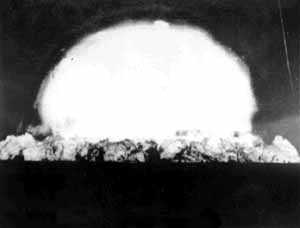
Atomic bomb research was taking place in Germany and other countries, but in the United States a massive effort to build an atomic bomb was launched in 1942. The code name was the Manhattan Project. This project was carried out in extreme secrecy with a nearly unlimited budget by many of the nation’s most outstanding scientists. On July 16, 1945, in the desert near Alamogordo, New Mexico, the US successfully conducted the world’s first nuclear test.
The Hiroshima bomb (Little Boy)
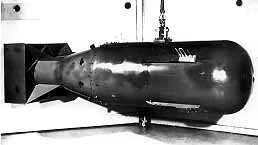
Length: Approx. 3 meters (120 inches)
Weight: Approx. 4 tons (9,000 lbs)
Diameter: Approx. 0.7 meters (28 inches)
Element: Uranium 235
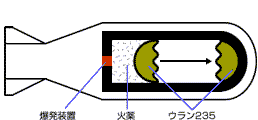
Because of its long, thin shape, the Hiroshima bomb was called Little Boy. The fissile material was uranium 235. The uranium was divided into two parts, both of which were below critical mass. It was a “gun barrel-type” bomb that used an explosive device to slam one portion of uranium into the other, instantly creating a critical mass.
When a critical mass is available, a chain reaction takes place instantaneously, releasing energy far beyond the capacity of ordinary explosives. The energy released by the Hiroshima bomb was originally thought to be equivalent to the destructive power of approximately 20,000 tons of TNT. Later estimates based on damage to buildings and studies of the bomb’s structure have reduced that figure to approximately 15,000 tons. It is believed that this enormous energy was released by the fission of slightly less than one of the 10 to 35 kilograms of uranium 235 in the bomb.
The Nagasaki Bomb(Fat Man)
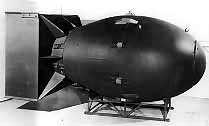
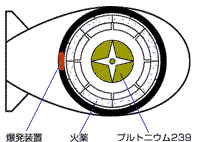
Length: Approx. 3.2 meters (128 inches)
Weight: Approx. 4.5 tons (10,000 pounds)
Diameter: Approx. 1.5 meters (60 inches)
Element: Plutonium 239
Compared to the one used on Hiroshima, the Nagasaki bomb was rounder and fatter, so it was called “Fat Man.” The fissile material was plutonium 239. The plutonium was divided into subcritical portions and packed into a spherical case. To cause the chain reaction, gunpowder around the periphery of the case was used to force the units to the center. Thus, it was called an “implosion-type” bomb.
The fission of slightly more than one kilogram of plutonium 239 is thought to have released destructive energy equivalent to about 21,000 tons of TNT.